Press Release
By Candace Roulo
Global Media Relations Manager & Copywriting
As the electric vehicle (EV) share of the automobile market continues to grow, there is the need to take a fresh look at hybrid and EV thermal management systems. Speaking at the ITB Thermal Management Systems & Materials Conference 2024, in Novi, Michigan, Russell Bloomfield, Application Development Manager, presented a session about the performance of proven PPA and PPS materials developed for these systems, along with findings from chemical exposure tests conducted with dielectric fluids related to immersive cooling.
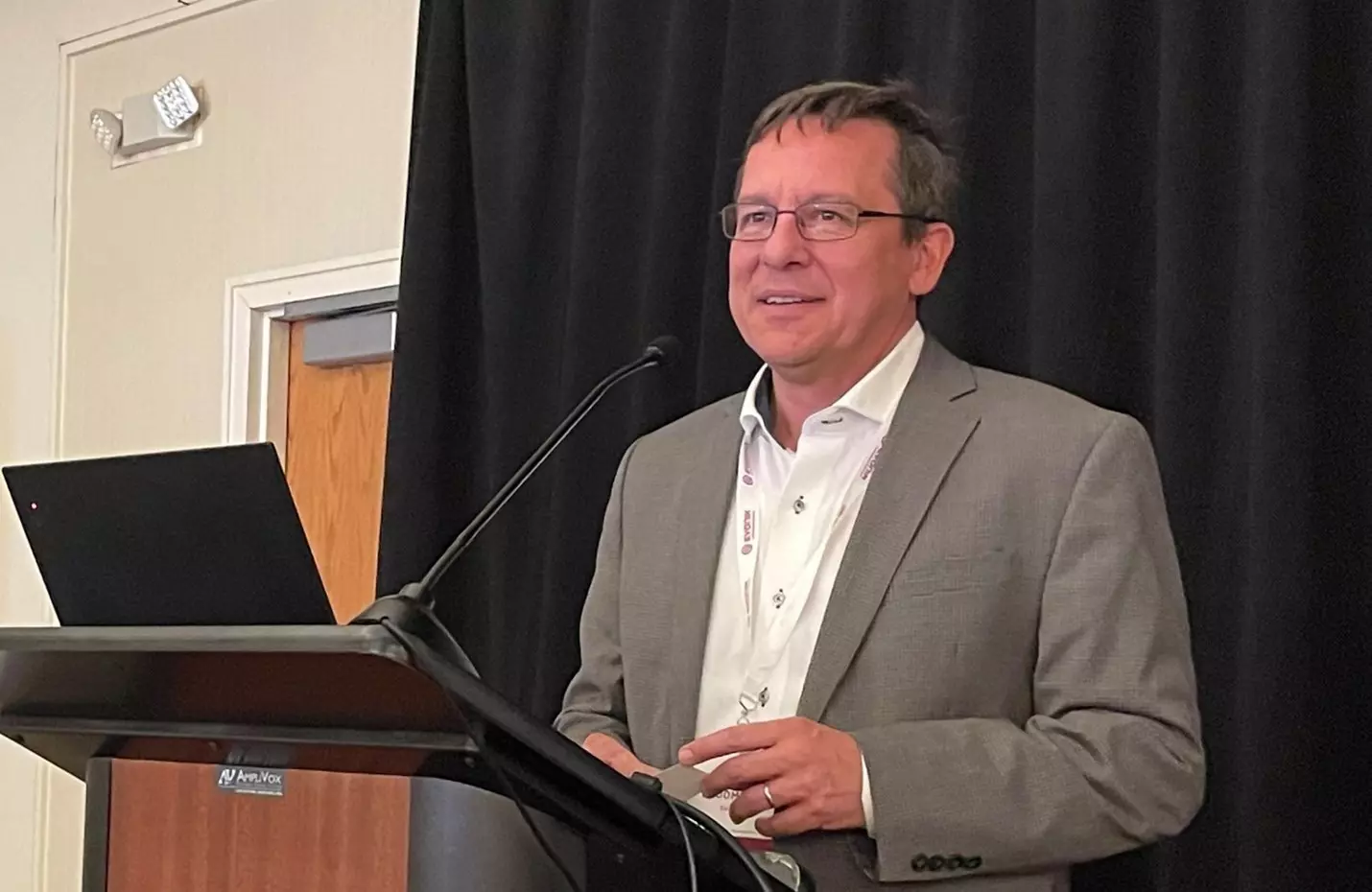
Speaking at the ITB Thermal Management Systems & Materials Conference 2024, in Novi, Michigan, Russell Bloomfield, Application Development Manager, for Envalior Americas, presented a session about the performance of proven PPA and PPS materials developed for hybrid and EV thermal management systems.
During the session, Bloomfield introduced Envalior’s new hydrolytically stabilized PA6 material offering superior creep and fatigue performance, compared to GFPP materials, to the 160 suppliers and OEMs in attendance. Also, with the advent of immersive cooling as a means of maximizing heat transfer, Bloomfield shared findings from long-term chemical exposure tests conducted with select dielectric fluids.
Exposure duration is one of the biggest EV thermal management challenges engineers face when predicting the long-term performance of the system. Coolant aging time increases from 1,500 hours to 6,000-30,000 hours! Engineers need to ensure material integrity in regards to both water glycol coolant resistance for battery electric vehicle as well as ionic purity for fuel cell vehicles. Aspects of both are increasingly important for ensuring robust thermal management performance. Furthermore, with the complexity of thermoplastic parts, the presence of weld lines often prove to be the “weak link in the chain” when it comes to part integrity. Envalior has focused on this performance aspect as we characterize the long-term behavior of our materials.
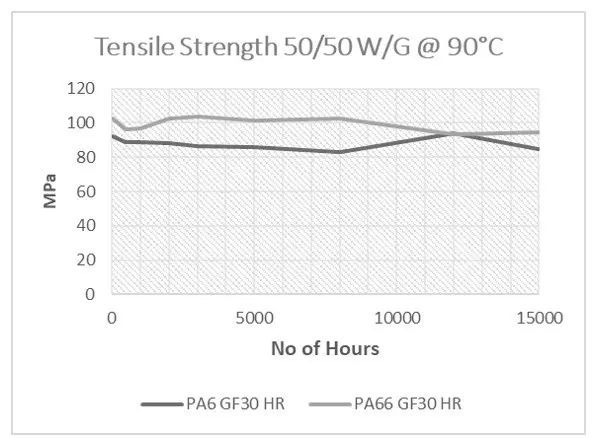
The new Envalior PA6 HR material delivers excellent long-term property retention.
“Positioning thermoplastics for thermal management should consider aspects of time, temperature, and design,” explained Bloomfield. “For a given condition, oftentimes the mechanical property capability of a PPA-based solution is attractive initially; however, depending on the long-term coolant exposure condition of relevancy, one may find that the comparatively stable performance of PPS can show a long-term performance benefit over PPA. The same consideration can apply to a discussion specific to PP GF versus PA6 GF. In this case, for example, the load response at 80°C reveals a distinct benefit of PA over PP. This is not apparent when simply consider a datasheet or room temperature performance.”
Immersion cooling involves having systems such as EV battery cells or E motors directly immersed in a dielectric fluid. The benefit of this thermal management approach is driven by a higher and more uniform heat transfer coefficient as compared to what is achievable with traditional indirect coolant systems.
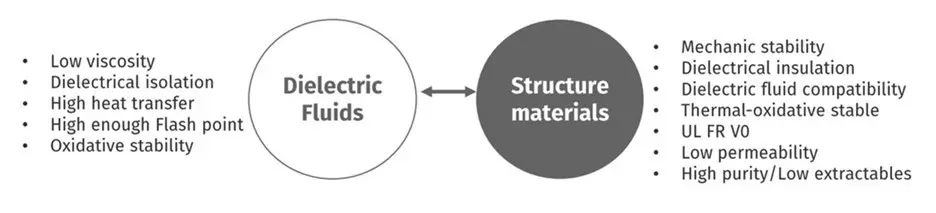
Although there are no commonly regarded “industry standard” at this time, Envalior can test to the needs of a customer’s application.
We have experience with exposure testing of commercially available dielectric fluids in contact with relevant Envalior materials:
We also monitor fluid integrity in conjunction with plastic exposure.
Bloomfield also touched upon Envalior’s traditional materials portfolio for internal combustion engine coolant applications during his presentation. “The foundation for positioning thermoplastics in contact with coolant is to understand how the material may change both in terms of reversible effects of fluid uptake as well as long-term chemical change” said Bloomfield.
“Envalior offers a newly launched suite of on-line modelling tools which allow the user to estimate the mechanical properties of our materials as a function of not only temperature, but also moisture condition,” said Bloomfield. “These associated insights can allow one to more accurately model the effects of moisture and conditioning on the performance of polyamide-based materials.”
Having an understanding of how different material types are affected by traditional coolant exposure informs both the material choice as well as the associated design considerations.

Candace Roulo is Global Media Relations Manager & Copywriting for Envalior. Based in Troy, Michigan, she specializes in writing blogs, press releases and articles about advanced materials solutions. Prior to joining Envalior, Candace served in editorial roles at SME and Penton Media. Candace earned her bachelor’s degree in communication, specializing in public relations, at Michigan State University’s College of Communication Arts and Sciences.